[vc_row][vc_column][vc_column_text]
APART FROM ALL THE OTHER failures that government policy in response to Covid-19 is likely to be remembered for, its outcomes for social care service users are likely to endure as a national scandal. What we also have to hope is that they can serve as a unique opportunity to initiate progressive change.
Social care has been a case study of the short-termism of modern UK politics. For years across parties, successive governments relied on the mantra of integrating health and social care, without making any fundamental change.
Symbolically the ministry was renamed the Department for Health and Social Care. In reality, the two policies couldn’t be more different and accordingly more impossible to integrate successfully.
On one side we have the NHS, survivor of welfare state principles, still largely free at the point of delivery and paid for out of general taxation, despite all the privatising efforts to undermine it from within. On the other side, social care, a relic of poor law principles, with means and needs testing still central to its operation.
This ongoing mess, responsible for much suffering, doubtless many premature deaths and enormous organisational waste has long been headlined as a chronic crisis. However, Prime Minister Johnson has taken it to a new level. Given that the worst consequences of the virus mainly affect older and vulnerable people, we could guess from the start that good social care support would be at a premium. Even though we already knew this, there was no mention of improving social care in the spring budget. When late in the day emergency legislation to address Covid-19 was introduced, it actually restricted access to social care rather than improved it.
Prime Minister Johnson has signalled very clearly his commitment to the continuing separation of what are two inseparable state responsibilities. The story and the strategy are shocking in their cynicism and disregard for human life and human rights. Thus we see the encouraging of a clapping hour for NHS staff and ignoring the basic safety needs of those in social care.
Such service users and their carers have been left isolated, inadequately supported and not even included in the formal death lists from the virus at the time of writing. But the emerging headlines, even from Johnson’s captive press, still gave the game away. By mid-April it was admitted there had been outbreaks at more than 2,000 care homes. The CEO of Age UK accused the government of “airbrushing older people out” of the pandemic “as if they don’t matter”. The Labour Party called on the government to publish daily figures of deaths in care homes to highlight the true scale of the spread of Covid-19. And still no testing, an acute shortage of protective gear and ventilators, months not weeks after the outbreak was first evident.
Even Sky News, not exactly the crusading Manchester Guardian of the old days, has headlined this as “a scandal our grandchildren will ask about” and the Daily Mail calls out the “care homes catastrophe”. We can guess the suffering; we don’t even know how many are dying and how many staff may ultimately share the same unnecessary fate.
Meanwhile, without breaking ranks, the media have resorted to hagiography at the level the Romanian leader Ceausescu demanded. We have had daily bulletins about our brave leader’s health alongside death statistics in rising thousands among the rest of us which we can only link to his delays and obfuscations. Only that other beacon of neo-liberalism, Trump’s United States can match our death rate and, pro-rata for population, the UK is even worse.
This pandemic was always going to be difficult, confusing and disturbing for those most at risk – for people with Alzheimers and for many mental health service users – with the possibility of damaging isolation for some disabled people and people with learning difficulties. But the inadequacy of social care, government incompetence and lack of leadership have resulted in something incalculably worse. It will be a long time probably before we know the scale of this and the indirect as well as direct casualties.
But Johnson’s preoccupation with himself, spin and perhaps ‘getting Brexit done’, must be our opportunity to press for the radical reform of social care that no major political party has so far had the courage to commit itself to. We must at last get the Labour Party on board to spearhead this.
In proposing longer term solutions the Reclaiming Our Futures Alliance (ROFA), an alliance of deaf and disabled people and our organisations in England, urge policy makers and politicians to adopt a much wider vision for a service. ROFA has been calling for a legal right to independent living delivered through a national independent living support service (NILSS) for the last three years, modelled on an expanded version of the Independent Living Fund which the government closed in 2015.
We agree with Andy Burnham, Manchester’s mayor, that this service should be modelled on the NHS, free at the point of need with the workforce on similar pay and conditions. However, social care and disability operate on a social, not medical model and disabled people have driven changes and innovations which must not be lost in the scramble to create a solution to the crisis of the middle classes losing their inheritance through a ‘dementia’ or ‘death’ tax. Therefore, it needs to sit alongside the NHS, organised nationally but delivered locally through new organisations, located in the public/not for profit sector, with staff on public sector terms and conditions of service.
Our vision tries to keep people out of residential institutions for as long as possible so it includes housing policy and the building of all new homes to lifetime accessibility standards, transport, employment, inclusion in education and the de-institutionalisation of the so-called assessment and treatment units (ATUs), responsible for so much abuse and deaths of people with autism and learning difficulties. What is missing in all the current discourse is the voice and agency of the users of social care services – disabled people of all ages. It is time government and the Labour Party stopped playing lip service to “Nothing About Us Without Us” and started to bring us into the centre of decision making.
The Labour Party now has the chance to break the social care deadlock that has blighted the lives of generations of older and disabled people for years. It has already taken the first crucial steps. Labour’s commitment to create a National Care Service underpinned by the principles of ethical care and independent living is a start.
But we must be clear what we mean by independent living. Its real meaning of enabling disabled people to live on equal terms with non-disabled people is now enshrined in the United Nations Convention on the Rights of Disabled People (UNCRPD) Article 19. But the term independent living has been degraded by successive UK governments. Labour has to make clear its commitment to the UN version as the driving force for its strategy and to co-produce policy and solutions with disabled people – ‘Nothing About Us Without Us’. The motion to establish a National Independent Living Support Service (NILSS) passed at last year’s conference is the way forward based on disabled people’s vision: https://www.rofa.org.uk/independent -living-for-the-future/.
A future Labour government unlike its predecessors will have to sign up to the spirit as well as the letter of the CRPD. To achieve this it will need to:
-
Break from past social care tradition and ensure its policy focus extends equally to disabled children and working-age disabled people as well as the older people who policymakers have traditionally restricted their focus to.
-
Bring social care into the public sector. This means effectively socialising the existing antiquated residential care which is a market dominated by avaricious and unaccountable financial organisations and interests.
-
Review the role of traditional big disability and carers’ charities preoccupied with their own institutional/business interests.
-
Look beyond local authorities as the main and natural home for the organisation of support services and provision. Local government will have a role to play in the generation and regulation of the social care ‘market’.
-
Close all residential institutions for disabled children, working-age adults and people with autism and learning difficulties and ensure inclusive alternatives.
-
Shift the emphasis away from residential care to comprehensive community-based support for older disabled people.
-
Have a clear and defined role for an independent and effective regulator. Currently the commissioning, assessment and charging for social care is outside the inspection remit of the failing Care Quality Commission (CQC).
-
Expand the role of disabled people’s (DPOs) and user-led organisations (ULOs) as support providers, advocates, welfare rights advisers and peer facilitators.
-
Grow new, less hierarchical delivery structures like user-led organisations, co-ops and not for-profit social enterprises.
Here lies a real vision and future for social care, transformed into a National Independent Living Support Service, providing high-quality services, employment and opportunities that won’t be dominated by austerity and the profit motive. NILSS will, at last, be as loved and valued as the NHS. It will be seen as an economic generator consistent with commitments to sustainability, rather than a drain on the public purse, as it frees service users and their loved ones to have the fullest, equal and active lives.
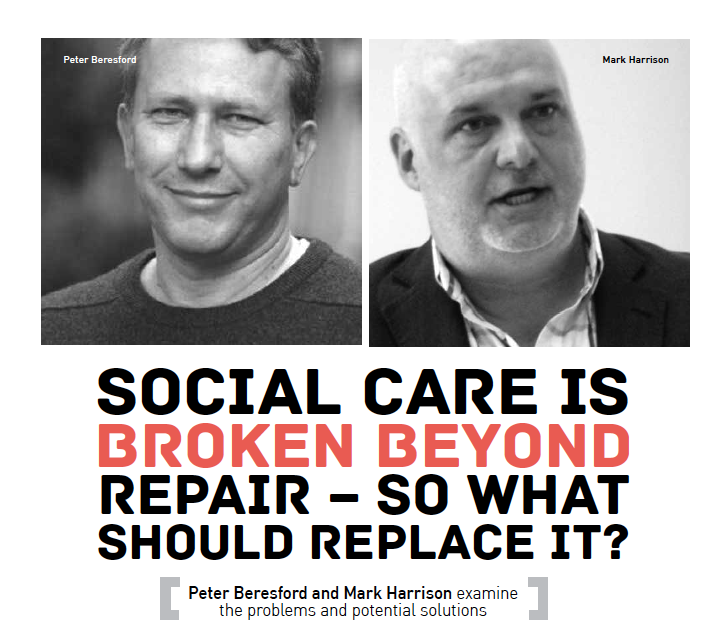
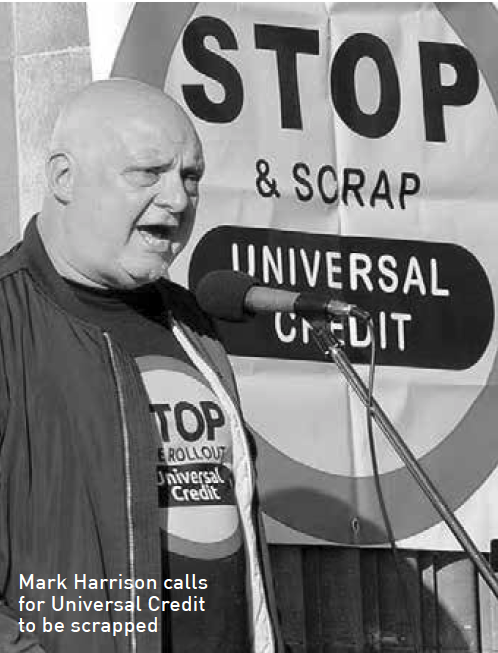
Mark Harrison is director of Social Action Solutions, and Senior Research Fellow in Social Action at the University of Suffolk.
Peter Beresford is co-chair of Shaping OurLives, the disabled people’s and service users’ organisation and network, and Professor of Citizen Participation at the University of Essex.
[/vc_column_text][/vc_column][/vc_row]