[vc_row][vc_column][vc_column_text]
Mark Harrison and Peter Beresford review gains made in recent years
Finally there appears to be a breakthrough for co-production. Twenty years into the new century all the gains made in social theory in the latter part of the 20th century and the early years of this one are finally beginning to bear fruit. This is by no means universal but there are some clear examples emerging of meaningful involvement in policy, practice and user-led research to draw on that we can say are optimistic.
Notions of co-production have been around for more than a decade now. What started as a positive and optimistic alternative to the consultation culture with all its tokenism quickly ground to a halt due to austerity, particularly in health and social care. Co-production provides a new paradigm for developing health and social care. Research by the Social Care Institute for Excellence (SCIE), 2009, by Dr Catherine Needham and Sarah Carr illuminates the transformative nature of this approach
» Co-production is a potentially transforming way of thinking about power, resources, partnerships, risks and outcomes. It requires a shift in culture within statutory organisations – with professionals able and confident to share power and accept user expertise, leading to ‘no decisions about us without us’. Co-production can deliver service models which are preferred by the public, more cost effective and less wasteful.
» Co-production emphasises that people are not passive recipients of services and have assets and expertise which can help improve services.
» Co-production is a potentially transformative way of thinking about power, resources, partnerships, risks and outcomes, not an off-the-shelf model of service provision or a single magic solution.
» “To act as partners, both users and providers must be empowered”. Co-production means involving citizens in collaborative relationships with more empowered frontline staff who are able and confident to share power and accept user expertise.
This approach is important as it puts a shift in power relations right at the heart of the process. Sharing power with community members by politicians, policy-makers and practitioners goes against the grain. It also goes against much professional training and qualifications where students have to demonstrate their knowledge and expertise in doing things to, for and on behalf of people they are paid to work with. To shift to a culture that encourages sharing knowledge and power requires a radical, if not revolutionary, shift.
Progress tends to be uneven as we saw with the policy development in the Labour Party in the lead up to the last two general elections. There was good co-production in some areas like the development of the transformational Green New Deal, but in others, like disability and the policy on social care, it was dominated by the voices of the professionals and the sectional interests. The voice and engagement with disabled people and the users of services was ignored or drowned out.
Unfortunately, over a decade on, finding examples of meaningful co-production feels like looking for needles in haystacks. There is also an economic argument for co-production, as well as being the ‘right thing to do’. The importance of ‘upstream engagement’ is emphasised because if you don’t get it right at the beginning of the process then it is far more expensive to undo or remodel at a later stage. The example of the built environment is a case in point.
Retro-fitting building with ramps and replacing stairs and lifts are expensive and a waste of money. Road traffic calming measures like shared space have become the new fashion and many councils have spent huge sums of money creating schemes that are dangerous for disabled people, particularly blind people, some of which are now having to be undone or modified to make them safe and compliant with other legislation. If only they had talked with a blind person and tested it out with their guide dog before spending the money!
Here are a couple of examples which pass the co-production ‘litmus test’.
The Commission on Social Security: www.commissiononsocialsecurity.org represents a ground-breaking co-production initiative developing proposals for a better UK social security system. All the commissioners are people with lived experience and the proposed solutions have been developed by those with direct experience of the benefits system.
Following a call for ideas for a better benefits system which received over a thousand responses, the public are now being asked what they think about the ideas in a second wave of consultation. Ideas in the proposals include; establishing a guaranteed decent income so everyone has a secure, reasonable amount of money coming in; getting rid of the benefit cap; raising child benefit to £50 per child per week; ending zerohours contracts; and a social model approach to disability benefit.
Input has been invited from anyone interested in improving the benefits system: experts by experience, user-led groups and claimants, thinktanks and charities, policymakers and the general public. Following the public consultation, a White Paper with policy recommendations will be drawn up.
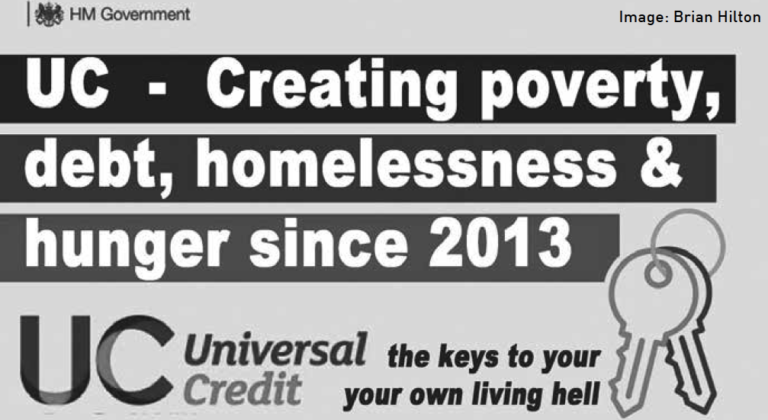
What’s distinctive about the process is that it puts centre stage the knowhow of people who understand what it is like to be on benefits. Respondents were asked eight questions, ranging from how to make Universal Credit better, to the ideal level of benefit payment, to what best to do about benefit sanctions. These suggestions were then reviewed by the commission which is now putting forward eight ideas it has identified for public consultation.
The second case study is from the London Borough of Hammersmith and Fulham (LBH&F). The groundwork for this initiative was forged on the picket line when disabled people and Labour opposition councillors stood together against the then Tory regime’s cuts to services. When Labour came to power, they engaged two disabled activists to lead the council’s co-production initiative. They also scrapped charges for social care at a time when other councils, including Labour ones, are increasing charges on disabled people for their social care.
For LBH&F, co-production is an approach where residents / citizens are working together in an active way to plan, design and review policies and services that affect their lives. It stems from the recognition that it is not possible for public sector organisations to use public money to deliver needed and sustainable support and services effectively without co-production. LBH&F is the first – and to date remains the only – borough in England to commit to a cross-council co-production strategy to ensure that disabled people take a lead in how local infrastructure, initiatives and local policies are developed.
Eight co-production recommendations for transforming public services came from the work of Hammersmith & Fulham Disabled People’s Commission, led by disabled residents. The LBH&F Co-production Implementation Group (HFCIG), which oversees the implementation of the recommendations, includes membership from disabled residents, councillors (including cabinet members) and senior staff – www.lbhf. gov.uk/councillors-and-democracy/ co-production.
There is also another interesting development in Greater Manchester where Andy Burnham’s mayor’s office has engaged the local disabled people’s organisation (DPO), the Greater Manchester Coalition of Disabled People (GMCDP), to convene and facilitate a panel of disabled people to co-produce policies and programmes with gmcdp. com/gm-mayor-panel which is worth following.
Sadly, the opportunities now coming the way of co-production should not hide from us the real threats that the genuine article still also faces. There can be no question that the Johnson government represents the most reactionary, incompetent and ideologically driven administration since the creation of the post-war welfare state. For an administration committed to the ‘small state’, ironically, its tentacles extend everywhere from weakening our public health defences to spurious questioning of the future of tanks in the British army.
This doesn’t mean we give up or assume the quest for truly equal and inclusive co-production is halted. But we have to be on constant guard against tokenism, co-option and phony partnerships. A recent online conference on the subject highlighted the complexities and ambiguities. As international participants contributing to an important and far-reaching discussion, our host, a mental health service survivor currently in a psychiatric facility, was repeatedly being told off for not getting on with eating her dinner, which was pointedly left outside her door by an irritated staff member. This was even though she had forewarned the NHS paid-for private service in advance that the virtual event was taking place.
Not surprisingly, experienced service users are increasingly cautious about the reality of co-production in these difficult times. Crucially if a really diverse range of service users are going to have a fair chance of being effectively involved in co-production on equal terms, then there needs to be a preparatory stage of support for their empowerment, otherwise only the most confident, assertive and skilled are likely to take the plunge.
Yes, we must be cautious and watch out for the bear traps lying in wait for us, but at the same time there are real pressures supporting rising interest in co-production, user involvement and user-led research. We need to see these as the public policy equivalent of the current revolution in electric cars and bicycles. It’s the way to go and we’ve just got to keep going to help everyone to make that shift! It’s not petro-chemical research that’s needed any more, but how we can work in flatter, more collaborative, equal ways to co-produce more sustainable futures.
Mark Harrison is director of Social Action Solutions and Senior Research Fellow in Social Action at the University of Suffolk.
Peter Beresford is co-chair of Shaping Our Lives, the disabled people’s and service users’ organisation and network, and Professor of Citizen Participation at the University of Essex.
[/vc_column_text][/vc_column][/vc_row]